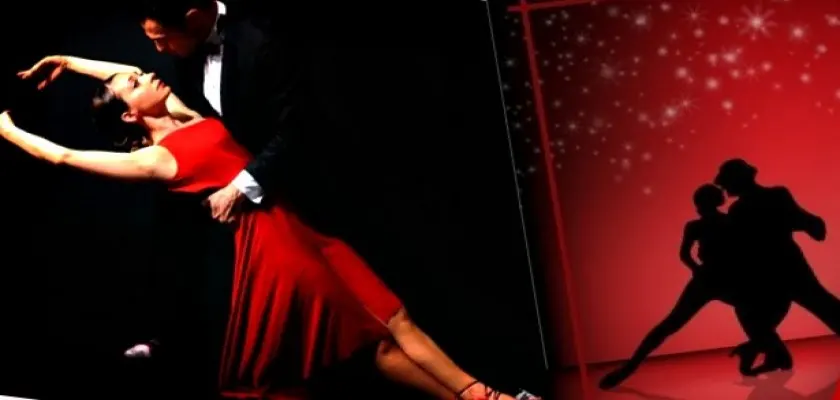
Tango Dance Styles
Apart from Fantasia nuevo and tangos, all other tango dance styles are performed with closed embraces. Also, although salon and orillero style tangos are danced with open embraces, they are typically performed with closed embraces in Buenos Aires and other parts of Argentina. Milonguero and club style tangos are also typically performed with closed embraces, and the distance between the lady's left shoulder and the man's right shoulder is usually the same as the distance to the lady's right shoulder. Additionally, some figures explained in the tango nuevo sections are performed in closed embraces in mild degrees and V-shapes in salon, orillero, and club style tangos. At this point, embraces and frame become quite important.
Rhythms of Dance Styles
On the other hand, according to some, the difference between milonguero and other tango dance styles is that in the milonguero style, the frame is within the lady, while in other styles, the frame is in the arms of both dancers. Also, whether the frame is within the lady or in the arms depends on the closeness and softness of the embraces to a large extent. In stiff and distant embraces, the frame is in the arms, and the closer and softer the embraces, the more the frame moves into the ladies' bodies in every style
. It is a way of defining the rhythmic elements prominent in the tango music performed by Ric tic Juan D’arienzo, Rodolfo Biagi, and many other orchestras.
Some dance styles argue that ric-tic rhythmic music is in 2/4 time, while others disagree and claim it is in three against two time. Also, some orchestras played tango music in 2/4 time and added a syncopated three against two rhythm. However, other orchestras played in 4/4 time while adding a three against two rhythm to their music. It should be known that all tango steps are sometimes explained in slow forms and sometimes in very fast forms. However, these explanations are always considered a guide to finding the correct rhythm rather than a precise definition. In tango dance forms, steps are generally described as follows: slow, fast, or one-two-three.